Private health insurance plan analysis: choosing the right plan and insurer
A plan analysis systematically checks which plan and which insurer fit in the long term: when you choose before signing as well as in an existing contract. What matters is premium development, plan hygiene, premiums for children and exit options, not the cheapest entry price.
What really matters when you choose a plan and where the savings levers lie in an existing contract.
01
Premium development beats entry price
What matters is not the starting premium, but how a plan is calculated and how its premiums have developed over the last 10 to 20 years. No comparison calculator shows this calculation philosophy.
How an insurer maintains its plans over the years decides on future premium jumps. Online comparisons hardly take this factor into account.
03
Do not underestimate premiums for children
Insurers sometimes differ considerably in the price for children. A plan that is cheap for adults can become a permanent extra burden with several children.
Savings lever in an existing contract: 10 to 30 percent
With insurers that have a large plan family, savings of 10 to 30 percent are possible by switching to a cheaper sister plan, without new health questions. We recommend an analysis every five to seven years or after every larger premium adjustment.
Choosing the right plan in private health insurance is one of the most important financial decisions of your working life. Contrary to what is often said, it is not only about the current premium, but about long-term premium stability, quality of benefits, flexibility and portfolio quality.
Online comparison calculators, for example from Check24 or Verivox, can offer a first orientation. They do not, however, replace sound advice on private health insurance. In this article we show what really matters when you choose the right plan, which criteria are decisive in the long term and what a plan analysis with us looks like in practice.
Choosing the right insurer
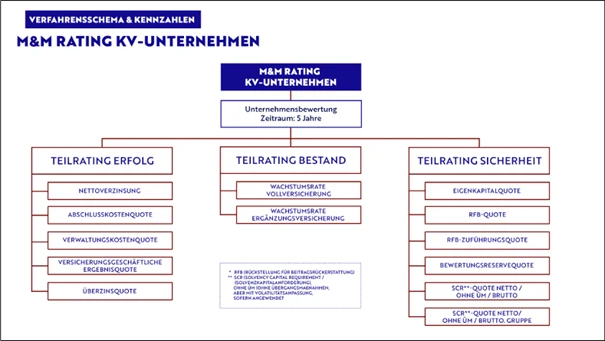
Our assessment of insurers is based on the Morgen & Morgen rating for health insurers, which evaluates the insurers as a whole over a period of five years. It rests on three central partial ratings:
Success: earning power and efficiency, measured among other things by net interest yield, cost ratios and underwriting result.
Portfolio: development and growth of the portfolio, especially in comprehensive and supplementary insurance.
Security: financial stability, for example equity ratio, provisions, valuation reserves and solvency ratios.
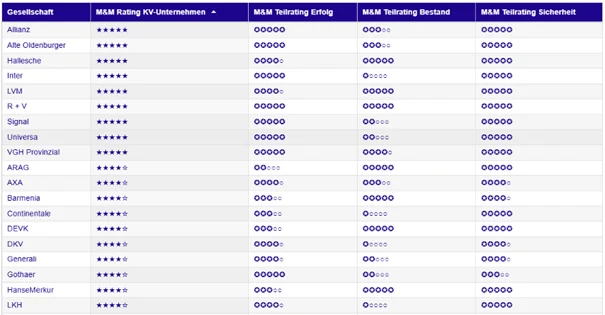
The rating makes one thing clear. The choice of the right insurer should not rest on single figures or snapshots, but on a long-term view of stability, profitability and portfolio quality.
The Morgen & Morgen rating evaluates health insurers over five years by success, portfolio and security.Overall rating of selected insurers over a period of five years.
Premium development in the past
A low entry price is one of the most common selection criteria in private health insurance. For a lasting decision, the premium development in the past says much more. Important questions are:
How often were the premiums adjusted over the last 10 to 20 years?
Were there stable phases or regular premium jumps?
How strong were the adjustments in comparison with the market average?
On which principles are the entry premiums of new plans calculated?
Many private plans differ less in their benefits than in their calculation philosophy. This only shows over the years, not in a comparison calculator.
Figures from the association of private health insurers on the price development of medical services show how strong the cost pressure in healthcare is:
Costs of one day of care in hospital: +37.5%
Costs of removing the tonsils: +16% (with 120% more cases)
Costs of a cardiac catheter examination: +29% (with 120% more cases)
Costs of medical aids, for example wheelchairs, prostheses and care beds, in 2024 alone: +10.4%
Hospital treatments in 2024 alone: +8.7% more cases
Increase in healthcare costs overall
Overall cost development according to figures from the association of private health insurers.
+4.7%
2022
+8.4%
2023
+10.7%
2024
Premium calculation of individual plans
New private plans do not automatically start cheaper than existing plans. What matters is how the insurer calculates the entry premium and how it compares with the previous plans.
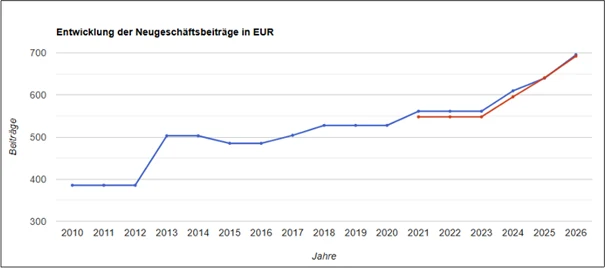
The following examples from our analysis practice show how new plans are calculated compared with existing plans and how the premiums develop. In each case, an older plan (blue) is compared with a new plan (red) at a similar level of benefits.
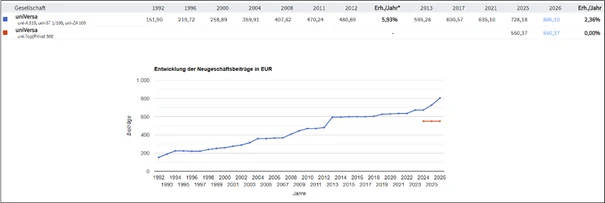
Universa: older plan uni-A310, uni-ST 1/100, uni-ZA 100 (blue) compared with the new plan uni-Top/Privat 300 (red).
The older Universa plan was adjusted moderately over many years. The average premium increase was about 2.36% per year, below the market average of 3.4% (association of private health insurers, 2006 to 2026). The curve of the new plan makes clear that, in our view, Universa offers the plan uni-Top/Privat 300 too cheaply. We therefore expect a higher adjustment in this new plan on January 1, 2027.
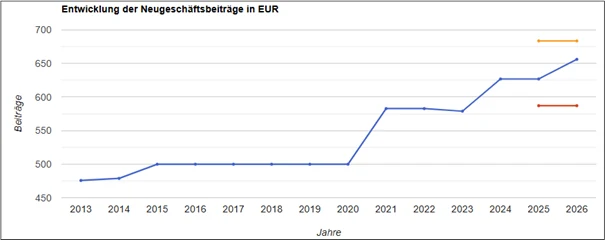
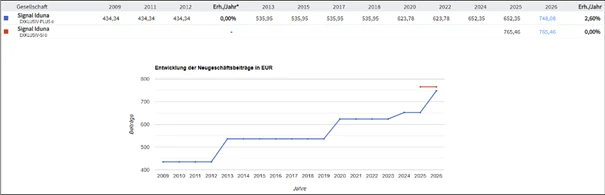
LKH: older plans A103, S200, Z80 (blue) compared with the new plans GUK500 (red) and GUP500 (yellow).Signal Iduna: older plan Exklusiv-Plus 0 (blue) compared with the new plan Exklusiv SI-0 (red).
The new plan Exklusiv SI from Signal Iduna deliberately does not start cheap. In our view, it takes the current cost developments in healthcare into account realistically. We therefore consider the premium calculation of Signal Iduna sensible.
Hallesche: older plan NK.Bonus (blue, 2.53% increase per year) compared with the new plan NK.select XL Bonus (red).
What does this mean for policyholders?
The charts show very clearly that new plans often do not start cheaper, but frequently already at the premium level that older plans only reached after many years of adjustments. The reason is simple. Insurers calculate new plans more cautiously and take known cost developments into account from the start. Older plans often start cheaper, but have to be adjusted more strongly over the years.
The comparison makes clear why the starting premium alone is not a reliable decision criterion. What matters is how a plan was calculated and how the premiums develop in the long term, regardless of whether it is an older or a new plan. Comparison portals usually do not take exactly these differences into account. We analyze real premium histories from practice, not just theoretical model calculations.
Costs in healthcare will keep rising in the future too, through new treatment methods, price increases and higher staff costs. This will continue to shape the premium development of private health insurance and the contributions of statutory health insurance.
Plan hygiene in private health insurance
The term plan hygiene describes how a private plan is maintained over the years. It is a central factor for premium stability and is hardly taken into account in online comparisons. It covers, among other things:
whether the plan is open to new customers
composition and ageing of the group of insured people
regular benefit updates instead of one-off corrections
a clean separation between old and new plan generations
Tariffs with poor plan hygiene often develop above-average premium increases, an unfavorable risk pool and limited switching options within the company. Our assessment is based on market observation and experience with existing customers, not on advertising claims of the insurers.
The price for children in private health insurance
When choosing the right plan, the price for children is often underestimated. Yet private health insurers sometimes differ considerably here. Points to consider are the amount of the premium for children, how premiums for children develop over time and the rules for adding newborns to the policy.
A plan that is cheap for adults can quickly become a permanent extra burden with several children. We therefore take current and future family situations into account, not only today's status.
Exit options and plan change
What happens when your circumstances change? No private plan is ideal for every phase of life. This makes exit options and flexible ways to adjust within private health insurance all the more important. Decisive points are:
adjustment when you change job or your income changes
sensible alternative plans with the same insurer
Many plans are attractive at entry, but later turn out to be a strategic dead end. We think the choice of plan through strategically, including possible switching options, before they become necessary.
What does a plan analysis with us look like?
With us, a plan analysis goes far beyond the monthly premium. We compare private plans in a structured way by deductible, benefits, plan hygiene, premium development, premiums for children, exit options and special features, to show transparently which plan really fits in the long term.
The following example shows an anonymized analysis from our advice. In the table, we write out the terms in full: deductible, no-claims refund, premium adjustment and employer.
Plan analysis for existing contracts: tools, process and benefits
What is a plan analysis for and when is it worth it?
⌄
A plan analysis in private health insurance is the systematic review of your own contract for potential to optimize it. The occasion is usually a regular interval of five to seven years, a larger premium adjustment or a change in your life situation such as self-employment, starting a family or retirement.
The three tools are the plan change under § 204 VVG, the comparison of premium adjustments over the years and the adjustment of the benefit profile. Together they give a clear picture of whether the existing plan still fits your situation. Unlike a comparison for a new contract, the analysis starts from the existing contract and protects the ageing reserves built up over the years.
How does switching to a sister plan help?
⌄
The most effective tool is switching to a sister plan under § 204 VVG. The right to change plan allows every privately insured person to switch to a cheaper plan with the same insurer without going through new health questions, provided the new plan does not contain higher benefits. The ageing reserves are kept in full.
The savings potential is 10 to 30 percent of the current premium. The key point is that the insurer rarely suggests this switch on its own. If you do not actively review your contract, you usually learn nothing about the cheaper sister plans from your own insurer.
What data does the review need?
⌄
If you want to check a plan change in private health insurance, you need two data sources.
Premium history: the development of the premium adjustments of your current plan over ten years. The comparison with the industry average of about 3.4 percent per year according to the association of private health insurers (2006 to 2026) shows whether the plan was more stable or more volatile than the market.
Benefit profile: the question of whether the plan still fits your current life situation. Increasing the benefits often requires new health questions.
Who should carry out the analysis?
⌄
You can do your own plan analysis, but it takes a lot of time and requires access to plan data that is not public. An analysis by your own insurer is not free of conflicts of interest.
We therefore recommend a specialized and independent advisor who has access to the plan data of several insurers and works solely in the client's interest. This makes it possible to reliably identify the right target plan from the whole plan family, which is the core of plan optimization. It is important that the recommendation stays traceable and is based on the verifiable data of the insurer, not on advertising claims.
What do we see in our advice?
⌄
In our advice, we observe a recurring pattern. Many policyholders have kept the same plan for ten or more years without knowing that cheaper sister plans exist with the same insurer.
We recommend an external plan analysis based on the insurer's data to existing customers who have been loyal to their insurer for over ten years. The savings potential is often in the double-digit percentage range of the annual premium.
What does an external plan analysis for private health insurance cost?
⌄
Independent advisors usually work on a commission basis, and a first analysis meeting is often free of charge. The costs should always be clarified in advance.
Can I apply for the switch under § 204 VVG myself?
⌄
Yes. The application goes directly to the insurer. Without knowledge of the plan family and the previous premium adjustments, however, choosing the right target plan is difficult.
What happens to my ageing reserves when I change plan?
⌄
When you switch within the same insurer under § 204 VVG, the ageing reserves are kept in full. This is the central advantage over changing insurer.
Switching to private health insurance is probably not advisable for you.
From the age of 55, admission to private health insurance is often possible only with restrictions. A late switch can also mean higher premiums.
It matters to us that a switch pays off for you in the long run. That is why we do not recommend a consultation when your answers already show that the conditions are rather unfavorable.
Not sure, or want to correct your answers? Feel free to contact us. We will help you assess your situation.
Switching to private health insurance is probably not advisable for you.
From the age of 55, admission to private health insurance is often possible only with restrictions. A late switch can also mean higher premiums.
It matters to us that a switch pays off for you in the long run. That is why we do not recommend a consultation when your answers already show that the conditions are rather unfavorable.
Not sure, or want to correct your answers? Feel free to contact us. We will help you assess your situation.